Collection record · Dress & textiles
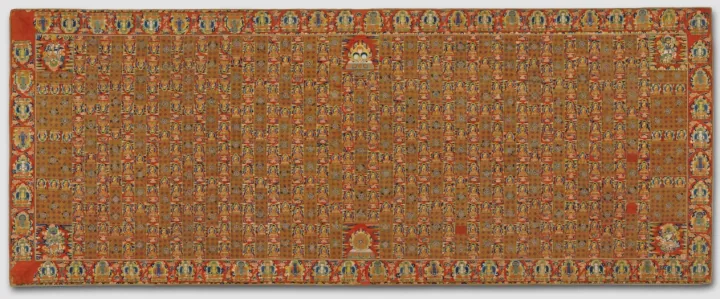
Cloth with Procession of Figures
The collection record classifies this work as textile. It is dated 170 BCE–70 CE (radiocarbon date, 95% probability). Recorded culture or place: Central Andes, South Coast, Nasca people.
Explore the object recordOBJECT RECORD
A closer look at the details.
- Museum title
- Cloth with Procession of Figures
- Date
- 170 BCE–70 CE (radiocarbon date, 95% probability)
- Culture / origin
- Central Andes, South Coast, Nasca people
- Materials and technique
- cotton and pigment (field); camelid fiber (borders and fringe)
- Dimensions
- Overall: 69.8 x 280.7 cm (27 1/2 x 110 1/2 in.); Mounted: 78.7 x 290.2 cm (31 x 114 1/4 in.)
- Artist / maker
- Not specified by the museum
- Museum
- The Cleveland Museum of Art
- Accession number
- 1940.530
FROM THE MUSEUM
In the museum’s words
The following description is reproduced from the Cleveland Museum of Art’s original English record.
Experts agree that this cloth is one of the greatest paintings to survive from Andean antiquity due to the realism, complexity, large size, and refined execution of its figures. All but one of the figures wear the whiskered mouth mask of Nasca supernatural beings and several carry or wear severed human heads, which the Nasca linked to nature’s fruitfulness. Thus, the figures seem to represent supernatural forces or humans personifying such forces during a ritual devoted to agricultural fertility. Originally, the panel was attached along its upper edge to a dark blue cloth of equal size. The complete textile may have served as a mantle (a shawl-like garment), a hanging, or a funerary offering.
FOLLOW THE SOURCE
Text and image sources
The Cleveland Museum of Art · The Norweb Collection · CC0
The summary is based on public collection data. Refer to the museum’s latest record for the title, date and attribution.
Open the complete museum record View the open-access policyTHE VISITOR BOOK
What caught your eye?
Opening the visitor book…