Collection record · Dress & textiles
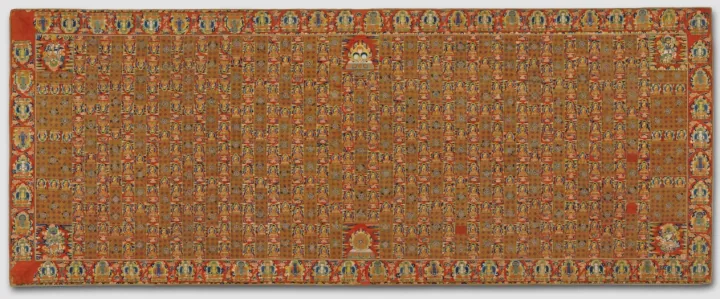
Textile with Palmettes
The collection record classifies this work as textile. It is dated 1200s–1300s. Recorded culture or place: Central Asia, Il-khanid (Mongol) period.
Explore the object recordOBJECT RECORD
A closer look at the details.
- Museum title
- Textile with Palmettes
- Date
- 1200s–1300s
- Culture / origin
- Central Asia, Il-khanid (Mongol) period
- Materials and technique
- Silk and gold thread; tabby with supplementary weft
- Dimensions
- Overall: 85.5 x 35 cm (33 11/16 x 13 3/4 in.); Mounted: 106.7 x 50.8 cm (42 x 20 in.)
- Artist / maker
- Not specified by the museum
- Museum
- The Cleveland Museum of Art
- Accession number
- 1993.253
FROM THE MUSEUM
In the museum’s words
The following description is reproduced from the Cleveland Museum of Art’s original English record.
Designs of repeated ogives were popular in Central Asia and survive in a number of variations. Usually, the ogival frame encloses a floral motif, as in this example. Sometimes paired animals occur instead. Silks with this type of pattern were exported to Western Asia and to Europe, where they inspired textile designs woven locally. Mongol silks with exotic floral and animal patterns were acquired for use as clothing and furnishings by the clergy and nobility. They were also used by painters as models for hangings or garments.
FOLLOW THE SOURCE
Text and image sources
The Cleveland Museum of Art · John L. Severance Fund · CC0
The summary is based on public collection data. Refer to the museum’s latest record for the title, date and attribution.
Open the complete museum record View the open-access policyTHE VISITOR BOOK
What caught your eye?
Opening the visitor book…