Collection record · Everyday wonders
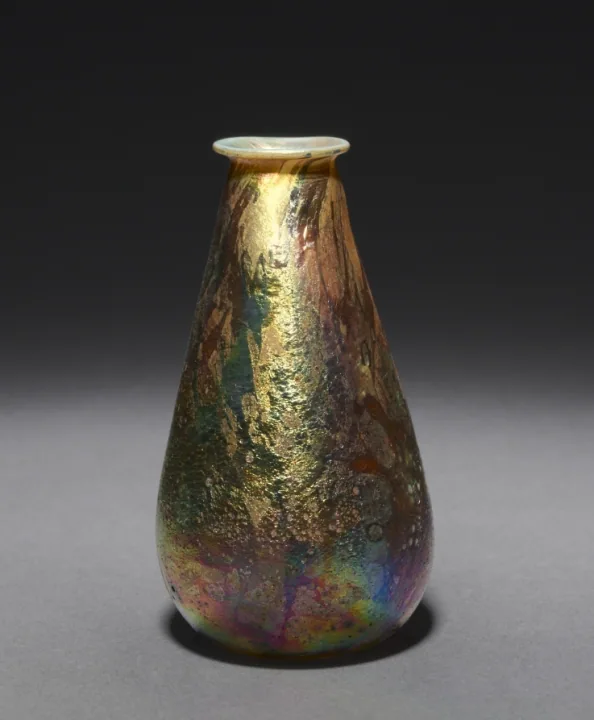
Gu-shaped Vase
The collection record classifies this work as ceramic. It is dated 1912–14. Recorded culture or place: Japan, Meiji period (1868–1912).
Explore the object recordOBJECT RECORD
A closer look at the details.
- Museum title
- Gu-shaped Vase
- Date
- 1912–14
- Culture / origin
- Japan, Meiji period (1868–1912)
- Materials and technique
- Porcelain with crackled glaze
- Dimensions
- 27.9 cm (11 in.); Diameter of top: 14.6 cm (5 3/4 in.)
- Artist / maker
- Seifū Yohei III (Japanese, 1851–1914)
- Museum
- The Cleveland Museum of Art
- Accession number
- 2022.223
FROM THE MUSEUM
In the museum’s words
The following description is reproduced from the Cleveland Museum of Art’s original English record.
Seifū Yohei III mined the repertoire of Chinese vessel types, from ceramics modeled after ancient ritual bronzes to shapes developed in the Yuan (1279–1368) and Ming (1368–1644) dynasties. His designs tended to be formal and restrained, often featuring creamy white glazes suggestive of the hue of Ding ware and green glazes resembling Longquan ware.
This gu-shaped vase has a cracked-ice glaze, which was once customarily called Ge (Japanese pronunciation Ka), after the kiln where it purportedly originated during the Southern Song dynasty (1127–1279). The glaze’s double-crackle pattern, featuring both deeper and shallower cracks, is called “gold threads and iron lines.” The effect was enhanced here by coating the vessel with ink or another stain, which was allowed to seep into the cracks before the surface was wiped clean.
FOLLOW THE SOURCE
Text and image sources
The Cleveland Museum of Art · Gift of James and Christine Heusinger · CC0
The summary is based on public collection data. Refer to the museum’s latest record for the title, date and attribution.
Open the complete museum record View the open-access policyTHE VISITOR BOOK
What caught your eye?
Opening the visitor book…