Collection record · Everyday wonders
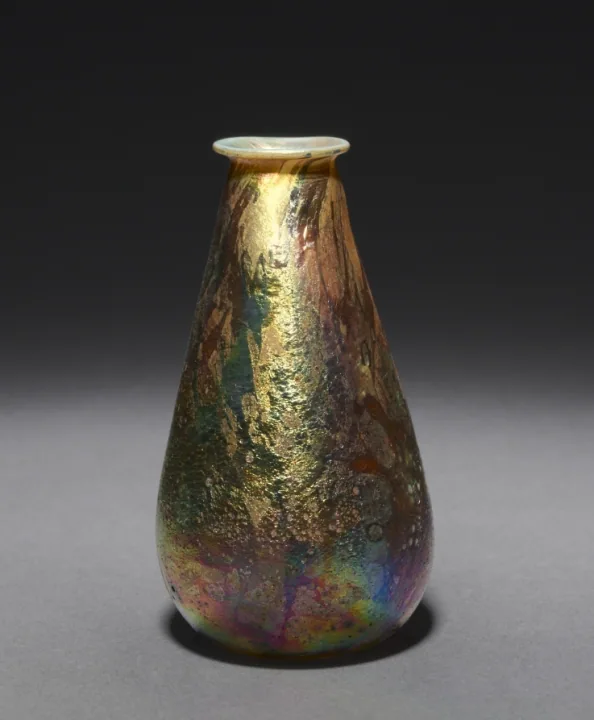
Pomegranate Vase
The collection record classifies this work as vessels. It is dated 1479–1425 BCE. Recorded culture or place: Egypt, New Kingdom (1540–1069 BCE), Dynasty 18, reign of Tuthmosis III (1479–1425 BCE) or later.
Explore the object recordOBJECT RECORD
A closer look at the details.
- Museum title
- Pomegranate Vase
- Date
- 1479–1425 BCE
- Culture / origin
- Egypt, New Kingdom (1540–1069 BCE), Dynasty 18, reign of Tuthmosis III (1479–1425 BCE) or later
- Materials and technique
- blue vitreous faience
- Dimensions
- Diameter: 5.4 cm (2 1/8 in.); Diameter of mouth: 1 cm (3/8 in.); Overall: 6.9 cm (2 11/16 in.)
- Artist / maker
- Not specified by the museum
- Museum
- The Cleveland Museum of Art
- Accession number
- 1914.612
FROM THE MUSEUM
In the museum’s words
The following description is reproduced from the Cleveland Museum of Art’s original English record.
This small, round-bottomed flask takes the shape of a pomegranate. The serrated petals or calyxes that trim the top mimic the turned-back outer husk that is characteristic of this fruit. The flask's aperture is small. Not native to Egypt, the pomegranate (Punica granatum) was introduced from western Asia or Cyprus in the first half of Dynasty 18, probably between the reigns of Amenhotep I and Tuthmosis III. The fruit's novelty, as well as its shape, most likely accounts for its tremendous popularity as a deluxe vessel form at this time. Perhaps best known in Egypt and abroad in the materials of faience and glass, the type also occurs in metal, wood, and stone.
FOLLOW THE SOURCE
Text and image sources
The Cleveland Museum of Art · Gift of the John Huntington Art and Polytechnic Trust · CC0
The summary is based on public collection data. Refer to the museum’s latest record for the title, date and attribution.
Open the complete museum record View the open-access policyTHE VISITOR BOOK
What caught your eye?
Opening the visitor book…