Collection record · Belief & ritual
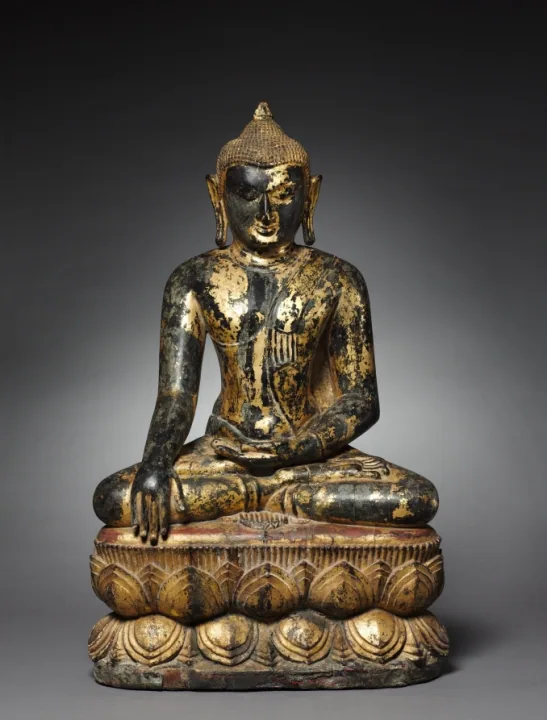
Buddha Calling on Earth to Witness
The collection record classifies this work as sculpture. It is dated 800s. Recorded culture or place: Northeastern India, Bihar, Tetravan, Pala Period (750-1197).
Explore the object recordOBJECT RECORD
A closer look at the details.
- Museum title
- Buddha Calling on Earth to Witness
- Date
- 800s
- Culture / origin
- Northeastern India, Bihar, Tetravan, Pala Period (750-1197)
- Materials and technique
- chloritic schist
- Dimensions
- Overall: 94 cm (37 in.)
- Artist / maker
- Not specified by the museum
- Museum
- The Cleveland Museum of Art
- Accession number
- 1935.146
FROM THE MUSEUM
In the museum’s words
The following description is reproduced from the Cleveland Museum of Art’s original English record.
This sculpture is one of a series that depict the Buddha at different scenes in his life. Here, he is at Bodhgaya, the place where he achieved enlightenment. At the top of the composition are the branches of the ficus tree with its heart-shaped leaves, under which he achieved enlightenment. His hand gesture indicates that he is calling upon the goddess of the earth to witness the moment. During the Pala period of the eighth through 12th centuries in medieval India, Buddhism dominated and flourished in major monastic universities. After the fall of the Pala dynasty, the numerous battles between small kingdoms vying for power caused the destruction of the Buddhist monasteries, and Buddhist monks fled with texts and movable art to Nepal, Tibet, and Southeast Asia, so that by the 14th century, Buddhism was eradicated in India.
FOLLOW THE SOURCE
Text and image sources
The Cleveland Museum of Art · Dudley P. Allen Fund · CC0
The summary is based on public collection data. Refer to the museum’s latest record for the title, date and attribution.
Open the complete museum record View the open-access policyTHE VISITOR BOOK
What caught your eye?
Opening the visitor book…